
by Peter Berg
This piece was originally published in Discovering Your Life-Place, written by Peter Berg, Planet Drum Books, copyright 1990.

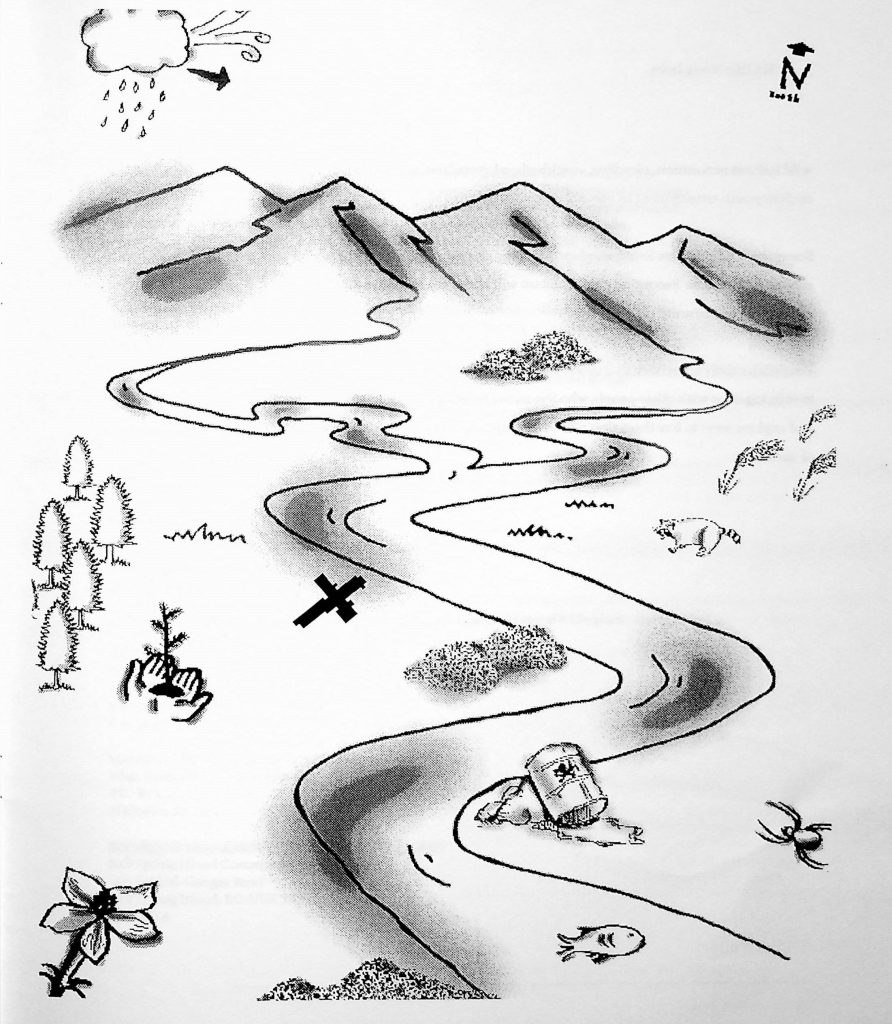
The map you’ve made is a view of your bioregion. It is also a kind of flag for the place. It shows your home base in terms of some of the natural elements that ultimately support life there. These elements need to be restored where they have been damaged and preserved where they are still intact. Some of them should be seen as appropriate sources for supplying basic human needs of food, water, energy, and materials as long as this can be done in ways that are sustainable tor both people and other life.
A bioregional sense of place can become the basis for your view of the community. It’s easy to see that many community issues would benefit from this. They include land use and development decisions, water supplies and sewage treatment, education and health, and even staging local celebrations to recognize unique natural events such as the seasonal flowering or fruiting of native plants and appearances of wildlife. Local problems ranging from unemployment and poverty to transportation and utilities also have a bioregional aspect. They can be partially solved by projects to convert buildings and vehicles to use renewable sources of energy, create some self-reliant food production, recycle materials and water, or restore damaged ecosystems.
You will have a much fuller ecological picture of the place where you live because of a bioregional perspective, but it can also help lead to worthwhile jobs and a future profession. Rural and suburban places can all use some degree of ecological restoration, whether through reforestation, re-establishing wildlife populations, rebuilding soil, mending damaged water courses, or other small and large scale projects. City environments are not ecologically sustainable at the present time and will require vast amounts of work to become so. T here are many opportunities to do this through reconstruction of buildings, development of alternatives to private automobile transportation, community gardening, urban wild, habitat restoration, recycling, neighborhood revitalization, and social programs such as youth employment in various aspects of sustainability.
Someone who practices living-in-place possesses a personal quality that can’t be achieved otherwise. Becoming a reinhabitant will make you an authentic member of your life community.
Your map shows a territory that needs support and defense. You may eventually want to join together with other people who live in the bioregion to find out mote about it and explore ways to live there that will be appropriate for maintaining a unique part of the earth.

Peter Berg (1937-2011) founded the Planet Drum Foundation (planetdrum.org) in San Francisco in 1973. His creative work and activism spanned decades, ranging from script-writing while a member of the San Francisco Mime Troupe and writing manifestos for The Diggers in the 1960s to presenting at the UN World Environment Day conference on urban sustainability and the Ecocity World Summit in the 2000s. In recognizing the significance of the connection between society and ecology, Berg was a leading early thinker in the development of the bioregional movement. Further biographical information available at https://planet-drum.net.