
by Peter Berg
This piece was originally published in Discovering Your Life-Place, written by Peter Berg, Planet Drum Books, copyright 1990.
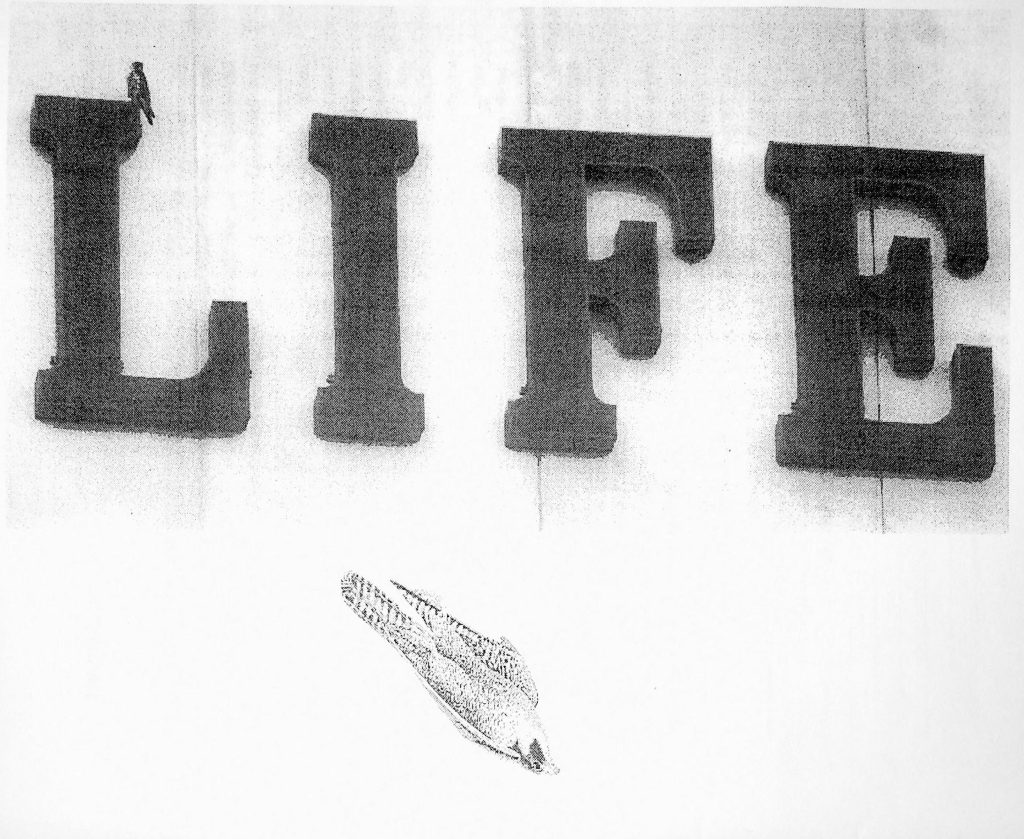
A few years ago workers in San Francisco’s downtown office buildings began noticing small bursts of feathers outside their windows. Office temps and CEOs alike would glance out to see a ball of down suddenly explode in the air and flutter to the earth fifteen floors below. As time went by, this phenomenon was discovered to be the work of peregrine falcons who were using the building roofs for hunting platforms before plummeting at nearly two hundred miles an hour to prey on unwary pigeons.
The falcons are enjoying what has become a very rich urban ecosystem. Some human beings sun themselves while sitting on park benches feeding pigeons. They don’t just bring stale bread. It might be fresh croissants or high grade bird seed that is tossed in fountain-like bursts onto the grass. The pigeons, who originated in the Mediterranean area and are more accurately called rock doves, have prospered extremely well in North American cities. While picking over generous gourmet handouts they have become greater in number and heavier as individuals. When they lumber into the air stuffed with popcorn or sourdough bread crumbs, they represent irresistible foreign delicacies for the diving native falcons.
The exploding feathers event has become a nearly daily occurrence and further observations revealed that some of the hunting birds have a favorite building with the eerily perfect words MUTUAL BENEFIT LIFE spelled out across the top. The male and female of the mating pair that use it choose to perch separately on the B of BENEFIT and the L of LIFE so that as the fastest animals on earth they can avoid disastrous mid-air collisions when they swoop down on their pigeon targets.
For some time it was assumed that the falcons lived on top of the buildings. It was easy to imagine a similarity between the canyons of skyscrapers and their normal habitat. The office building walls are like the flat cliff faces that these fast dropping birds prefer in the wild. The unpopulated and open roofs provide security from predators in a similar way as the small ledges and caves where they usually make nests. This premature conclusion was toppled by the ’89 earthquake that caused a span of the bridge across San Francisco Bay to fall. The bridge was closed to traffic for months and, in the absence of any other movement on it, falcons were seen flying in and out of the end of one girder. Inside was a pair’s nest and several eggs. Not only had these peregrine falcons converted an urban landscape into a wilderness for their own hunting purposes, but they did it by commuting to work.
The falcons’ success is a valuable lesson for learning how other living things can be revived and restored by thoughtful changes in human behavior. Only a few years ago peregrines were seriously threatened because DDT residues in their prey were affecting reproduction by thinning the shells of their eggs and making it easy for them to break in the nest. About a decade after DDT was banned in the United States, falcons who had been born in captivity were released and some of them found their way to downtown office buildings in many major cities including Chicago and New York. They have since become so numerous in all locales that they are no longer listed as an endangered species.

Peter Berg (1937-2011) founded the Planet Drum Foundation (planetdrum.org) in San Francisco in 1973. His creative work and activism spanned decades, ranging from script-writing while a member of the San Francisco Mime Troupe and writing manifestos for The Diggers in the 1960s to presenting at the UN World Environment Day conference on urban sustainability and the Ecocity World Summit in the 2000s. In recognizing the significance of the connection between society and ecology, Berg was a leading early thinker in the development of the bioregional movement. Further biographical information available at https://planet-drum.net.