
Dave Rollo of the Center for the Advancement of the Steady State Economy (CASSE) has published “Bioregional Regeneration: Whatcom County and Cascadia” in the Steady State Herald. It follows Regenerate Whatcom and Regenerate Cascadia, the bioregional network that grew in 2023 from a partnership between the Cascadia Department of Bioregion, the Design School for Regenerating Earth and the Regenerative Communities Network. The result is a clear picture of what bioregionalism looks like when it is practiced at the scale of a county, and of why it matters to the wider Cascadia movement.
A county inside a bioregion
Rollo begins with a simple point. County lines are drawn by people, and the systems a county depends on do not stop at them: water, food, work and ecosystems all cross the line. Whatcom County, which runs along the border with British Columbia, shows why that matters. It is planning for roughly 30 percent more residents by mid-century, its freshwater depends on glacial melt that climate change is shrinking, and its official planning still treats accommodating growth as a goal.
Deep local roots
The article traces Regenerate Whatcom through years of local organizing by David MacLeod, Brian Kerkvliet and their collaborators, who helped found Sustainable Bellingham, Transition Whatcom and the Salish Seed Guild, to its activation in 2023 during the Regenerate Cascadia Activation Tour. Rollo places that work in a longer lineage that this movement knows well: the history of Indigenous stewardship in this region, Peter Berg and Raymond Dasmann of Planet Drum in the 1970s, and the first Cascadia Bioregional Congress at Evergreen State College in 1986.
Mapping what usually goes unseen
Much of the piece centers on bioregional mapping, which Regenerate Cascadia’s Executive Director Brandon Letsinger describes as a layered way of reading a place. Regenerate Whatcom invites residents from many backgrounds to work on maps of the local water catchment, the term Kerkvliet prefers to watershed because it points toward keeping water rather than shedding it. Participants mark the places that are precious and need protecting, the places that are degraded and need repair, and the places where people are thriving. Laid over soils, topography, and plant and animal communities, those marks bring out the cultural connections that usually go unseen. Rollo argues that this gives residents something conventional development plans rarely do: a shared picture of their own place, drawn by the people who live there.
Funding that moves at the speed of trust
Rollo also looks at how the work is resourced. Regenerate Cascadia’s philanthropic support reaches its landscape groups through Cascadia BioFi, using flow funding: the landscape groups, not the parent network, decide which local projects and people receive grants. MacLeod describes this as a way to reach the points in a community where support does the most good, points that distant grantmakers rarely see, and he says the groups talk about “moving at the speed of trust.” The article also highlights Gaya Herrington, finance co-director for Cascadia BioFi, whose June 2026 keynote to the United States Society for Ecological Economics called for moving beyond growth toward an economy of human and ecological well-being.
A parallel path
The article closes on the hardest part of the work. Whatcom County’s newly finalized comprehensive plan still plans for growth and says nothing about carrying capacity. Yet residents have pushed back before; the City of Blaine voted to de-annex 573 adjacent acres. Regenerate Whatcom keeps inviting public officials into its mapping sessions, and a Public Utility District board member joined a recent one. CASSE’s Keep Our Counties Great program is calculating local ecological footprints, which MacLeod expects will help draw policymakers’ attention. His larger view, as Rollo reports it, is that alternative ways of living come before policy change: building a parallel path for living, and the community to walk it, is how growth gets challenged.
We are grateful to Dave Rollo and CASSE for this careful account, and to everyone in Whatcom who has been building this work for years. The article is now part of our In the News media list.
Read “Bioregional Regeneration: Whatcom County and Cascadia” at CASSE.
To learn more, visit Regenerate Whatcom on the Regenerate Cascadia site.
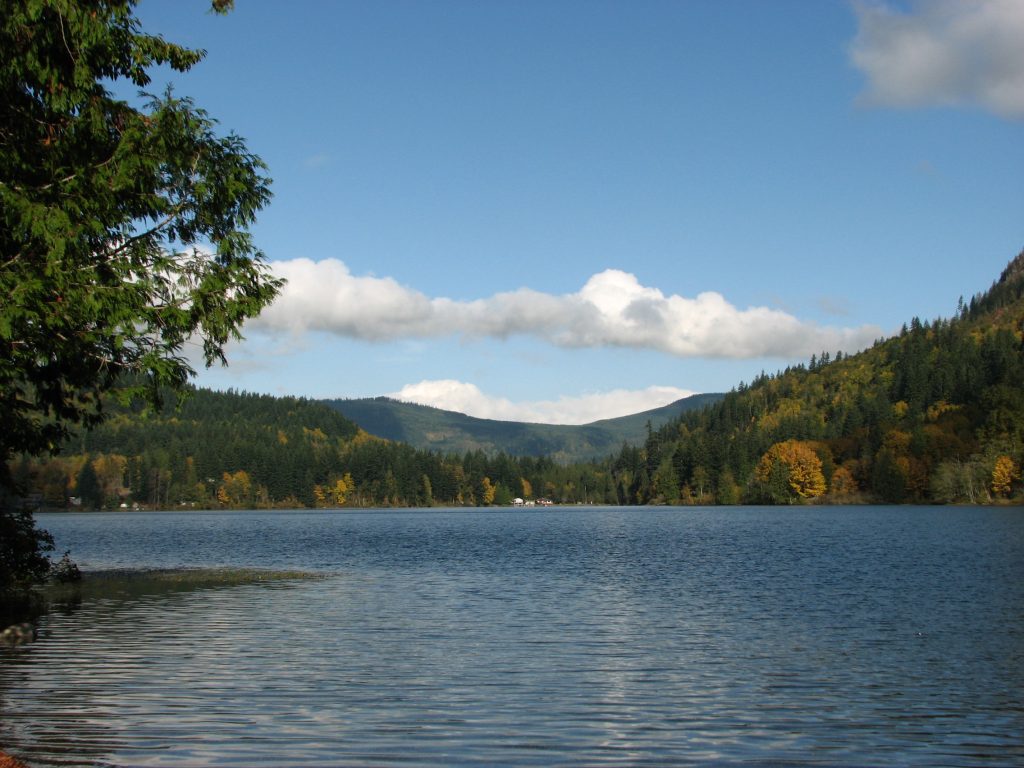
Photo: Silver Lake, Whatcom County, by Steven Pavlov, CC BY-SA 4.0, via Wikimedia Commons.
,_07.jpg)