
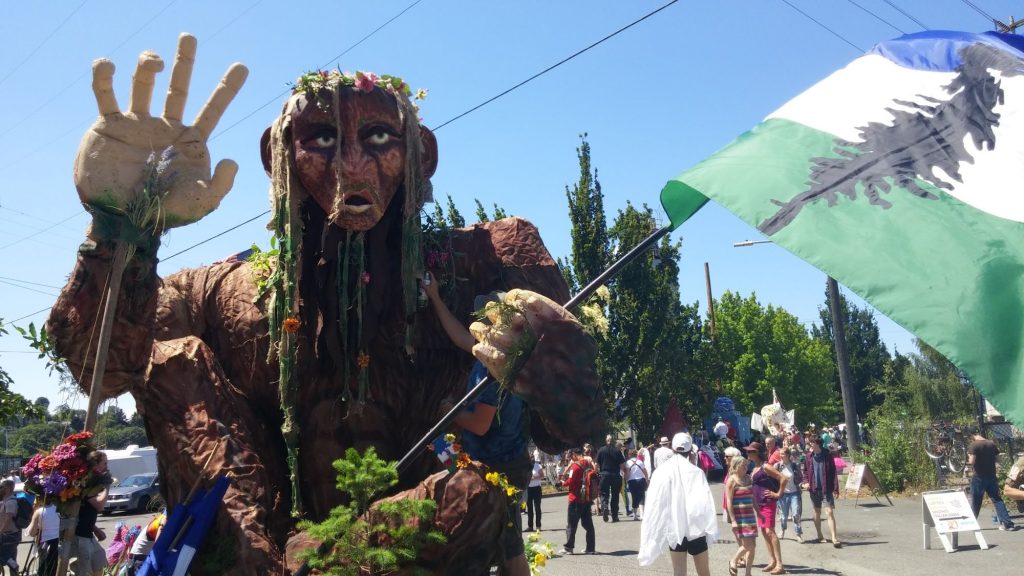
On October 13, CBC Radio’s Ideas, a program of the Canadian Broadcasting Corporation, aired “A Map of Cascadia.” It is the first of three programs on separatist and independence movements. Host Nahlah Ayed and a producer in Vancouver spend an hour on a question we care about: what ties people to one another and to the place where they live?
We want to say plainly how we heard it. The series frames its three stories as separatist movements. The Cascadia Movement is a bioregional one. We work for an independent, autonomous, and healthy Cascadia, which means self-governing communities and sustainable local economies organized around watersheds. The program ends close to that idea, and we are glad it does.
Two ways to read the same map
The producer begins with two maps of the region. On the first, the 49th parallel runs straight across the page and divides Canada from the United States. On the second, a relief map, the lines run north to south: the Coast Mountains, the Cascade Range, and a green corridor between the mountains and the sea that holds Vancouver, Seattle, and Portland. Cascadia, he says, is not a republic. It is a different way of looking at the map.
That is our starting point too. Cascadia is a bioregion, a place defined by its watersheds and landscapes rather than by political borders. The map below, Cascadia: A Great Green Land, shows what that looks like.

Many Cascadias, one idea underneath
The program finds Cascadia in several places. There is a small group of separatists. There is an economic Cascadia, such as the Cascadia Innovation Corridor, which links businesses and local governments across the border. There is an environmental Cascadia, where groups including Regenerate Cascadia, another program of the Department of Bioregion, do restoration work north and south of the line. And there is a Cascadia of everyday pride: the Doug flag on bumper stickers, the name on a pet store and a tap house, the Amtrak Cascades train between Vancouver, Seattle, and Portland. The producer also cites a 2025 poll by Research Co. in which 60 percent of British Columbians said they have more in common with people in Seattle and Portland than with people in Toronto and Montreal.
What the landscape does to people
Two researchers join the conversation. Fritz Götz, a psychologist at the University of British Columbia, studies how geography and personality interact. He describes large datasets in which people in mountainous parts of the United States, especially the western mountains, tend to be more open to new experiences, less extroverted, and less agreeable. He stresses that landscape interacts with culture and does not determine it. The producer adds that the old frontier thesis behind this work overlooked the Indigenous peoples already living on the land it called empty.
The program also raises the reputation Vancouver and Seattle share for being hard places to make friends. Götz has not studied that comparison. His idea that outdoor routines leave less time for conversation is a hypothesis, and the program presents it as one.
Words carry place
The linguist Julia Swan of San José State University studies a sound shift among some speakers in Vancouver and Seattle, and to a lesser degree Portland, in which the vowel in “bag” moves toward the vowel in “beg.” She does not claim there is one Cascadia accent. She does find the shift more common among people whose families have lived in the region for generations, and among speakers who resist rapid change in their neighborhoods, whether the pressure comes from the technology industry in Seattle or from housing costs and outside investment in Vancouver.
The program also notes that words such as “skookum,” meaning solid or very good, come from an Indigenous language and traveled with Chinook Wawa, a trade language that grew along the Columbia River. Long before English speakers arrived, this was a hot spot of Indigenous language and cultural diversity, and rivers carried words as well as goods.
Belonging at more than one scale
Ayed asks whether all this makes a nation. The producer answers that the things that bind people do not all pull the same way. A national border creates one kind of belonging through shared institutions, stories, and symbols. Mountains, rivers, and coastlines create another. Neither cancels the other, and a person can be both Canadian and Cascadian. He adds that activists who work on Cascadia are often not trying to abolish borders. They are trying to give those lines less weight, and the ecological and historical ties that shape who we are more.
We agree, and we would add one thing. Belonging to a watershed carries responsibility. The people who live in a place are best suited to care for it, and every community along a river should have real decision-making power over the land and water it depends on. That work carries forward a bioregional tradition active since the 1970s, and it acknowledges the Indigenous peoples who have lived here for thousands of years. It is open to anyone who calls Cascadia home.
Go deeper
If the episode made you curious, start with What Is a Bioregion? and our page on bioregional mapping, then create a free account to become a member and add your own events, photos, and news. CBC has been listening to Cascadia for some time. Its program The National reported on the movement in The Place They Call Cascadia, which is part of our archive. This episode now appears in our In the News list and on the News Articles page.
Thank you to the Ideas team for giving Cascadia an hour of their attention.
Featured image: a Sasquatch puppet beside the Doug flag, the Cascadia flag designed by Alexander Baretich. Map: Cascadia: A Great Green Land, second edition (2023), by David McCloskey, Cascadia Institute.