

by Peter Berg
This piece was originally published in Discovering Your Life-Place, written by Peter Berg, Planet Drum Books, copyright 1990.

The nearly miraculous appearance of wild hunting birds in urban areas is also a heartening symbol of how humans could rethink their own lives and reverse the deterioration of cities. To accomplish this we would first have to see ourselves as though we were falcons, that is, as part of an interconnected web of living systems.
The concept of a bioregion is uniquely useful for putting ourselves back into nature rather than on top of it. A bioregion is a way to describe the natural geography where one lives. It also identifies a locale tor carrying out activities that are appropriate for maintaining those natural characteristics. Bioregions have distinct features such as climate, soils, landforms, watersheds, and native plants and animals. They have also been sites tor adaptive long-term inhabitation by native peoples in the past, and they can be reinhabited by their present occupants.
To illustrate how starkly evident and contrastingly different natural elements can be, look at a physiographic (physical geography) map of Australia (see page 6). Darker areas represent either abundant vegetation or rugged land forms such as mountains, lighter areas are flatter or drier. Greater amounts of vegetation are indicative of greater rainfall. Landforms such as mountains or valleys create the water catchment basins or watersheds of creeks and rivers that rain follows when it moves on land through the pull of gravity.
What is bioregional about this map, considering that is shows no human signs? For an instant insight about human reliance on natural characteristics of local areas, answer this question: Where does at least eighty-five percent of the present Australian population live?
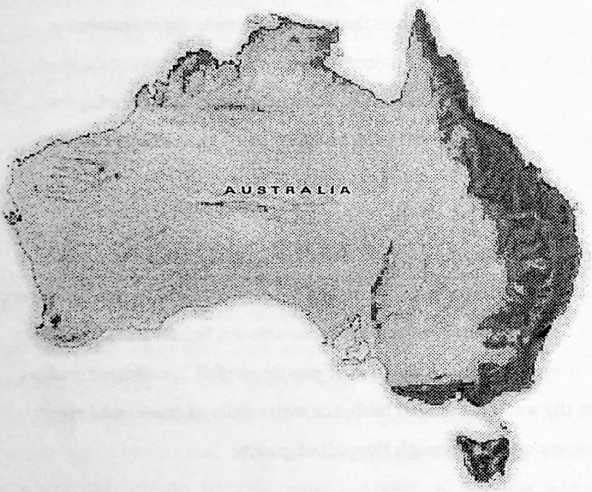
You’re right if you guessed that the vast majority are in the narrow strip that runs north to south along the east coast and contains most of the major cities. More people settled there because of the availability of water and good topsoil. The majority of the rest of the continent is much drier, extremely hot, and has little topsoil. This map provides a vivid portrayal of natural features that are critical to the relative density of human inhabitation.

Peter Berg (1937-2011) founded the Planet Drum Foundation (planetdrum.org) in San Francisco in 1973. His creative work and activism spanned decades, ranging from script-writing while a member of the San Francisco Mime Troupe and writing manifestos for The Diggers in the 1960s to presenting at the UN World Environment Day conference on urban sustainability and the Ecocity World Summit in the 2000s. In recognizing the significance of the connection between society and ecology, Berg was a leading early thinker in the development of the bioregional movement. Further biographical information available at https://planet-drum.net.