
September 2026 brought three large bioregional gatherings in three parts of the world, and on October 28 r3.0 (Redesign for Resilience and Regeneration) invited participants from each to compare what they had seen, in its fifteenth Bioregional Open Dialogue. One of the three was the Turtle Island Bioregional Congress in Vernonia, Oregon, for which the Department of Bioregion served as fiscal sponsor. This post summarizes the session, introduces the people who spoke and points to the recording and what comes next.
Three gatherings in one month
r3.0’s Bioregional Coherence Circle named September 2026 Global Bioregional Month to mark the overlap:
- The r3.0 Conference, held online, with more than 30 Confluences bringing bioregional groups together in person across five continents.
- The Turtle Island Bioregional Congress, September 15 to 19 at Camp Cedar Ridge in Vernonia. Our post on the Congress describes how Cascadians took part, and the organizers’ site, tibc11.earth, carries their reflections.
- The Mediterranean Bioregional Activation, convened in Tunisia by the Design School for Regenerating Earth.
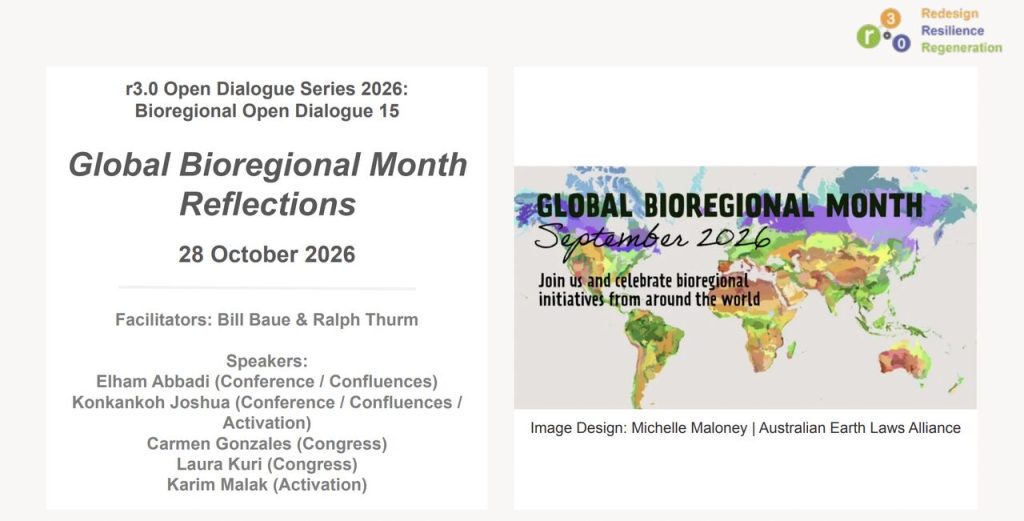
Michelle Maloney of the Australian Earth Laws Alliance designed the Global Bioregional Month graphic that serves as this post’s featured image.
The conversation
Facilitators Bill Baue and Ralph Thurm opened the floor to five invited speakers, and anyone attending could add reflections or questions. Konkankoh Joshua began with the image of an olive tree under which participants in the Mediterranean activation had gathered. He wondered what birds, which know no boundaries between continents or countries, and the tree itself might tell people about the way they make decisions for the living world.
Later, a prompt from Suzanne Richman, a longtime bioregionalist from the Northeast Woodlands bioregion, asked what role bioregionalism can play in the context of occupations. Karim Malak responded from the Mediterranean activation, Elham Abbadi from the Hima Corridor Confluence in Jordan and Carmen Gonzales from the Turtle Island Bioregional Congress. Laura Kuri reflected on the Congress too, joining her memory of co-hosting a Congress in Mexico in the 1990s to her part in leading this year’s Closing Ceremony.
Who spoke
- Bill Baue (facilitator) is Senior Director of r3.0 and helped organize the Turtle Island Bioregional Congress with its volunteer team.
- Ralph Thurm (facilitator) is Managing Director of r3.0 and represented the organization at the Mediterranean activation.
- Elham Abbadi leads the Bayoudha Village Farmers Cooperative in Jordan and works in sustainable agriculture. The UN Food and Agriculture Organization reported in 2022 that her women’s farming cooperative had planted more than 15,000 trees across eight villages in Jordan’s drylands. She reflected on the Hima Corridor Confluence.
- Konkankoh Joshua, also published as Joshua Konkankoh, is a Cameroonian elder and community organizer and a founder of the African Way Association. He developed the award-winning Bafut Ecovillage in Cameroon and is co-creating the African Peace Village in the western Algarve of Portugal. He joined the r3.0 Conference through the African Peace Village Confluence and took part in the Mediterranean activation.
- Carmen Gonzales spoke on a keynote panel at the Turtle Island Bioregional Congress and reflected on it at the dialogue.
- Laura Kuri, also published as Laura Valdés Kuri, is known as a founder of the bioregional movement in Mexico. She co-hosted a Congress in Mexico in the 1990s and is one of the earlier Congress organizers whom the 2026 organizers thanked for their counsel. In Vernonia she co-presented a session and co-led the Closing Ceremony.
- Karim Malak took part in the Mediterranean Bioregional Activation in Tunisia and reflected on it at the dialogue.
About the Open Dialogue series
r3.0 introduced the Open Dialogue in January 2024 after members of its community asked for it: a 90-minute Zoom call on a single theme, in which invited presenters frame the issues and participants from r3.0’s network and the public discuss them. A monthly series on bioregioning followed in 2025. Its opening session, Histories of Bioregioning, included Department of Bioregion Executive Director Brandon Letsinger, and Regenerate Cascadia’s account of that session remains online.
This year the dialogues have ranged from relationalized finance and Indigenous knowledge systems to funding flows across Turtle Island, BioHubs and a bioregional knowledge commons database. After each session r3.0 publishes the recording, slides and chat, and its Living Resources Document gathers the links shared across the whole series.
What it means for Cascadia
The Department covered r3.0’s Confluencing initiative in 2025, and the Congress added a continental gathering to that picture. With 2027 planned as a year of confluencing, converging and congressing in Cascadia, local teams organizing a confluence, event or gathering anywhere in the bioregion can request 501(c)(3) fiscal sponsorship from the Department at outpost@cascadiabioregion.org, and the Start a Group page is the place to begin.
Watch, read and join
- Watch the recording on YouTube.
- Read the slide deck (PDF).
- Open the Living Resources Document.
- Find every review material on r3.0’s Open Dialogues on Bioregioning page.
Next: Hima Revival. Bioregional Open Dialogue 16 takes place on Monday, November 30, from 2 to 3:30 p.m. UTC (6 to 7:30 a.m. Pacific). The Society for the Protection of Nature in Lebanon has revived the traditional Arab Hima system of community-based conservation since 2004, and its network now covers more than 60 sites, roughly 7 percent of Lebanon. Assad Serhal, Rami Kadro, Andre Bechara and Raghida Haddad are the speakers. Sign-up is optional, and the event page offers a calendar invitation.
Featured image: the title slide of r3.0 Bioregional Open Dialogue 15, with the Global Bioregional Month graphic by Michelle Maloney of the Australian Earth Laws Alliance.