

by Van Andruss
This piece was originally published in Home! A Bioregional Reader, edited by Van Andruss, Christopher Plant, Judith Plant, and Eleanor Wright, New Society Publishers, copyright 1990.

The following is a deliberately short list of books selected to introduce the reader to the basic perspectives of bioregionalism. Related books and articles abound in such numbers as to be countless. Remember that all books, articles and reports pertaining to your home bioregion could be relevant. Abundance of materials depends on where you come from.
Background
Regarding the history and philosophy of bioregionalism, it would be a pleasure to mention a few that have personally brought me along the path.
I have Lewis Mumford to thank for exploding illusions about the advantages of grand-scale civilizations. His work characterizing the Megamachine since its beginnings in the Near East and Egypt educated me to the nature of Empire, even before Murray Bookchin, The Fifth Estate (an anarchist journal from Detroit) and the more recent array of feminist literature filled in the topic. The great humanist, Kropotkin drew my attention to the tyrannical methods of the State in whatever guise. He favored instead the small-scale, locally self-governing communities like the Russian village, or mir. His outstanding contribution was to put scientific knowledge and history in the service of the people. Mutual Aid is the essential book of that generous person’s thought.
It is tempting to reach back into the 19th century and cite ancestors to a bioregional view. Kropotkin was one utopian thinker, and of course there were others, like the industrialist, Robert Owen, and the French theorist, Charles Fourier. Fourier had a big influence, incidentally, on those inspiring idealists at Brook Farm near Concord, Massachusetts, whose experiment in cooperative living enjoyed a brief but happy flowering. I’m referring to Sarah and George Ripley, Margaret Fuller and others. Not far away, Thoreau was penning his anarchist essay, “Civil Disobedience.” No single book adequately covers the ferment around the Concord of that period, though many treat of it.
Kropotkin, friends at Brook Farm, the Transcendentalists, Owenites, Fourierists—all human-scale social romantics of the 19th century—led me in the direction of bioregionalism.
I cannot proceed without mentioning the utopian experiments of our time in North America during the late sixties, early seventies. A short shelf of communitarian literature came out of this period, the most inspiring from Vermont. Those youthful days arc described in Ray Mungo’s Total Loss Farm, and in the collectively written work about the same domestic commune, Home Comfort.
Of history books preparing the ground for bioregionalism, the following pop into mind: Lewis Mumford’s The Myth of The Machine on the rise of patriarchal civilization; Edmund Wilson’s To the Finland Station on the rise of socialism; E.H. Carr’s The New Society on the antecedents to a “free enterprise” political setting; Murray Bookchin’s Ecology of Freedom on the institutions of hierarchy; L.S. Stavrianos’ Global Rift on the rise of the Third World; Leopold Kohr’s Breakdown of Nations, on the small nation imperative; Howard Zinn’s A People’s History of the United States on Empire-building the American way.
For the great work ahead, the more one learns about the earth/life sciences the better. An ecological perspective was brought home to me by Lynn Margulis’ Microcosmos and Early Life. Everywhere in her pages is the evidence that we live in a planetary interdependency, an all-species community of communities. Individualistic stances in nature are mistaken and maladaptive, while symbiosis (mutual benefit) is more properly the method of the new organic age.
Journals
Bioregional ways have been practiced by peoples since the beginning of human experience, but as a notion that figures in the popular mind, as an “ism,” it is new. The literature of the movement is to be discovered mainly in a variety of green alternative journals, with names like Coyote, Columbiana, North Country Anvil, The New Catalyst. Some of these publications have passed out of existence, others have survived. All speak eloquently and in a familiar manner about the life in their regions.
Journals appealing to a wider audience have played important parts in formulating the philosophy and generally spreading the word. I have in mind, for example, Coevolution Quarterly, Synthesis (now known as Green Synthesis), RAIN (no longer published), In Context and Raise the Stakes. Raise the Stakes, the voice of Planet Drum Foundation in San Francisco, has been a principal source during the whole life of the movement. This company of poets and social thinkers gave bioregionalism its original inspiration and is still going strong. Planet Drum Foundation has made available reprints of basic articles, mainly from Raise The Stakes, in their new Catalogue of Bioregional Primary Sources.
Early on, Coevolution Quarterly put out an excellent issue introducing bioregionalism, called “Bioregions” (Winter, 1981). Here the reader will find a series of illuminating articles back when the vision was fresh on the horizon. The Jim Dodge article, “Living by Life,” first woke me up to the active values of this view. Also in “Bioregions,” find a fundamental treatment of “The Concept of Social Ecology” by Murray Bookchin; and be encouraged to make community in a rural, hometown setting by “The Kansas Experience.”
More recently, The New Catalyst, Spring 1986, published a special issue on bioregionalism worth reading.
Along with journals, the bioregional literature includes a number of informally-printed booklets, papers and pamphlets like Paul Gilk’s populist statement, Nature’s Unruly Mob (North Country Anvil Magazine, 1986), Don Alexander’s Bio regionalism: Pseudo-science or Sensibility? (Trent University, no date), and the plain-spoken pamphlet of David Haenke’s called Ecological Politics and Bioregionalism (New Life Farm, 1984), certainly one of the historic rallying points of the movement. An early place-oriented volume is Gary Lawless’ The Gulf of Maine, an issue of The Blackberry Reader.
The publications above may not be readily available in a local library, but can be acquired through connecting up with the bioregional network.
Books
Reinhabiting a Separate Country: A Bioregional Anthology of Northern California (Planet Drum Foundation, 1978) gave us our first outstanding example of a “bioregional presentation” in book form. It is an imaginative evocation of the character of a home region through poems, interviews, essays, maps and pictures. Here is a joyous celebration of the Shasta people, their special terrain of consciousness, including the work of Raymond Dasmann on the physical layout of Northern California, “I am Looking at a Picture of Home.” This is a model discussion that could be applied to our own areas. The “Introduction” to Reinhabiting a Separate Country and the last essay called “Reinhabiting California” remain the most definitive statements around on the question, “What is Bioregionalism?”
Becoming in fact a separate country, dropping out of the nation-state, is the theme of Ernest Callenbach’s two novels, Ecotopia (Banyan Tree Books, 1975) and Ecotopia Emerging (Banyan Tree Books, 1981). They form a compendium of ideas on alternative culture. In the story, Northern California, Oregon and Washington split off and shape their society according to an ecological politics. Though the books offer a dubious portrayal of human nature, they arc fun and suggestive. A current utopian vision—highly recommended—is Always Coming Home, by Ursula LeGuin (Bantam, 1986).
Dwellers in the Land (Sierra Club, 1985) is a book that we’ve all had occasion to learn from. It was written by Kirkpatrick Sale to fill a gap. Until he undertook to do the work, no other formally-ordered book on bioregionalism existed. Dwellers in the Land is best used in a course of study. A good index is included as well as a rich “Bibliography and Notes” for further inquiry. All chapters are informative, but I especially recommend “Past Realities” for its short history of regionalism in the U.S. We are reminded here that bioregionalism is a form of regionalism. Interesting historians and planners are reviewed, namely Frederick Jackson Tumor, Lewis Mumford and Howard Odum.
A new publication portraying a bioregional philosophy through interviews, Turtle Talk: Voices for a Sustainable Future (New Society Publishers, 1990), is the first of The New Catalyst magazine’s “Bioregional Series.” Including Gary Snyder, Peter Berg, Starhawk, Freeman House, Caroline Estes, with an excellent Forward by Kirkpatrick Sale, Turtle Talk offers a stimulating set of conversations about key aspects of bioregionalism.
*
The books that follow are not wholly about bioregionalism but contain elements belonging to it.
A familiar work, and one close to my heart, is Brian Tokar’s The Green Alternative: Creating an Ecological Future (R. & E. Miles, 1987). The special value of The Green Alternative is in its summary description of the global green movement, which provides an appropriate background to bioregionalism. Both the movement in Europe and the U.S. arc covered, offering a wealth of events and actions by which the term “green” is defined. The book as a whole sees bioregionalism as a preferred strategy within the wider green movement. An intelligent book you wouldn’t hesitate to hand over to friends or relatives, even those likely to disagree. Exceptionally complete “Notes on Sources” arc a treasure for the avid reader.
No Foreign Land (Pantheon Books, 1973) by Wilfred Pelletier and Ted Poole is another book with an essential place in a bioregional picture. This is the story of Wilf Pelletier, an Ojibway from Manitoulin Island on Lake Huron, in Ontario, who finds the personal meaning of community in his home village after travelling deep in the territory of competitive white society. Knowing both the native and the non-native worlds, Wilf is able to bring out the differences with great accuracy. The experience is a revelation to those brought up in the psychology of individualism. Despite the spineyncss of the topic, the beauty of this book is in its accessibility and warm friendliness. See especially the chapter, “Home is Here.”
Basic Call to Consciousness (Akwcsasnc Notes, 1978) is without doubt one of the most powerful books on our shelves. Again, it is written from the point of view of native North Americans. It stands as a critique of Western Civilization through the eyes of a tribal people, the Haudcnosaunce (or Iroquois). This is the story of the twenty-one delegates who travelled with passports issued by their own nation to Geneva where they pleaded their case for survival before a United Nations assembly. For its expressiveness as a cultural view, its approach to governance and to life on the land, this book should be an inspiration to all bioregionalists. It is profoundly philosophical and might easily change your life.
A related book comes to mind, entitled Healing the Wounds: The Promise of Ecofeminism (New Society Publishers, 1988), edited by Judith Plant. This includes a feminist critique of His-story as well as asserting our connectedness with all life forms on the planet. It is not far from a native perspective itself. Feminism is one of the strong elements of a bioregional approach, which builds on the fundamental desire to care for all things. The editor is herself a bioregionalist and a partner in compiling Home!
Three other basic books presenting a feminist perspective are Susan Griffin’s Woman and Nature: The Roaring Inside Her (Harper, 1978); Carolyn Merchant’s Death of Nature: Women, Ecology and the Scientific Revolution (Harper, 1980); and Starhawk’s Truth or Dare: Encounters with Power, Authority and Mystery (Harper, 1987).
The problem of racism remains poorly understood in the bioregional movement as elsewhere. Several books have helped me along the way. Wendell Berry’s The Hidden Wound (Houghton-Mifflin, 1970), which is one American’s attempt to come to terms with a racist heritage; and Vincent Harding’s There Is A River (Random House, 1981), a magnificent account of the black struggle in the U.S. from the colonial period to the end of the Civil War.
Permaculture is another strand of the green movement and is practically one with bioregionalism. Its focus is on effective methods of reinhabiting the land. Its great advocate is Bill Mollison who has been writing and lecturing on the subject for years. A big tome of a book, Permaculture: A Designer’s Manual (Tagari Publications, 1988) has recently been published and looks indeed like an encyclopedic work on the subject. The permacultural view covers seemingly all aspects of alternative life—community organization, economics, agriculture and restoration.
An earlier work on planning and design is Bioshelters, Ocean Arks, City Farming: Ecology as the Basis of Design by Nancy Jack Todd and John Todd (Sierra Club Books, 1984). This is the fruit of a decade’s experience in research at the New Alchemy Institute in Massachusetts. Also see the sourcebook produced by the people at Tilth called The Future is Abundant: A Guide to Sustainable Agriculture (Tilth, 1982) concerned with environmentally-sound approaches to forestry, farming and gardening in the Pacific Northwest. Another valuable book on reinhabiting North America is Meeting the Expectations of the Land: Essays in Sustainable Agriculture and Stewardship (North Point Press, 1984) edited by Wes Jackson, Wendell Berry and Bruce Coleman. And for a history of the corruption of agriculture in the U.S., a devastating account, sec The Unsettling of America by Wendell Berry (Sierra Club/Avon, 1972).
For those seeking ideas concerning the reinhabitation of the city, an important work is Knowing Home, Studies for a Possible Portland (Rain Umbrella Inc., 1981). A more recent publication is A Green City Program: for San Francisco Bay Area Cities and Towns, written and edited by Peter Berg, Beryl Magilavy and Seth Zuckerman (Planet Drum, 1989)…. There is a great deal of experimental inquiry to be done in this area. A Green City Program represents an informative, creative introduction to the task. Just published, see also Green Cities: Ecologically Sound Approaches to Urban Space by David Gordon (Black Rose Books, 1989).
Speaking of design and planning, I want to mention one more source: Doug Aberley’s unpublished master’s thesis, Bioregionalism: A Territorial Approach to Governance and Development in Northwest British Columbia, completed at the University of British Columbia in 1985. From this study, perhaps the only one of its kind, I have learned better what it means to do the real footwork of bioregionalism—gathering the data on the home region, marking out the boundaries, creating the maps and overlays, making up the charts, researching the history of the place and its people from the archaeological past, their adaptations, and the practices of civilized people in recent times, the facts on their economy, trade and industry. In a bioregional study like this, one literally becomes intimately familiar with a certain part of the earth and the activity that goes on there. Of course it is infinitely complex, but one starts somewhere, as the author has shown. This is a bioregional study of the land of the Skeena River in Northern British Columbia, showing how our special bias can be made presentable for public discussion. A valuable tool for regional organizing anywhere. Bioregionalism: A Territorial Approach is no doubt available to those, again, who go seeking in the network (see the Bioregional Directory).
North American Bioregional Congress Proceedings
The Proceedings from the three North American Bioregional Congresses, the first in 1984, offer the reader an inside view of bioregionalists at work and play. To us it seems all very interesting. The Proceedings are printed in book form, obtainable from the two “bioregional bookstores:” The New Catalyst, Box 189, Gabriola Island, B.C. VOR 1X0 Canada; and Planet Drum Foundation, Box 31251, San Francicso, CA 94131, U.S.A.: $10 each. These pages show us in our serious deliberations, our workshops and plenaries, our ceremonies and circles. This is our tribe. We are assembled from all over the continent. Songs, poems, presentations, resolutions, opinions and many photographs display the cultural beliefs of the people. An important resource for anyone interested in actually joining the movement.
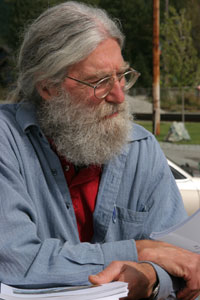
Van Andruss is a publisher, editor, and grassroots democracy activist in Yalakaom Valley, British Columbia. He is the former owner of Macleod’s Books in Vancouver. He’s publisher and editor of Lived Experience, a journal of writers from British Columbia which has released annual issues since 2001.