
BC Separatism and the Cascadia Movement: A comment blog by D.A.L., on the February 9th, 2026 article published in Canada’s National Observer, authored by Wolfgang Depner.
For further information on this topic, please also refer to the following sources:
Cascadia in Popular Culture: A simplified glossary of the Cascadia Movement. Webpage, Cascadia Dept of Bioregion.
Site Announcement: Turtle Island Bioregional Congress 11 - Blog, Cascadia Dept of Bioregion, Feb 3, 2026.
Cascadia Innovation Corridor 2025: Building a Bioregional Future Together - Blog, Cascadia Dept of Bioregion, Sep 4, 2025.
It’s time for Washington and Oregon to work for an independent Cascadia - Cascadia Journal, Andrew Engelson, May 13, 2025.
Four Secession Concepts to Save Independent Oregon from the ... Willamette Week-May 17, 2017.
A Bioregional Declaration of Interdependence - Seattle Weekly-Nov 16, 2016.
#CalExit gets some Northwesterners dreaming about Cascadia region -GeekWire-Nov 15, 2016.
Cascadia or Canada? #CalExit talk of Washington joining Canada - seattlepi.com-Nov 15, 2016.
Bioregionalism and Civil Society: Democratic Challenges to Corporate Globalism. (Book) (Sustainability and the Environment 9). UBC Press, Carr, Mike. 2005.
The Watershed Source Book: Watershed-Based Solutions to Natural Resource Problems. Boulder. University of Colorado: Natural Resources Law Center, 1996.

A Portland Timbers fan waves the Cascadia flag as he celebrates a second half goal during their MLS soccer game against the San Jose Earthquake on Tuesday, July 3, 2012, in Portland, Ore. Portland won 2-1. (AP Photo/Don Ryan)
“Cascadia movement has its roots in the past, but does BC separatism have a future?”
Canada’s National Observer, Wolfgang Depner. 9 FEB 2026
See the complete article here.
Canada’s National Observer recently published a well-documented and timely article by journalist Wolfgang Depner, and here at the Cascadia Department of Bioregion (C-DoB), we felt it deserved recognition and reflection; plus, it mentions our organization.
In today’s political context, it is important for C-DoB to address the renewed interest in bioregionalism. This revitalization is no coincidence given the current political climate, but it also calls for discernment. Depner’s article articulates that while “separatist conversations can be useful, it’s important to distinguish Cascadia as a bioregional movement from the often very different motivations behind current separatist rhetoric in Western Canada.” At a time when people from all walks of life may be seeking new models of governance, C-DoB encourages these seekers to look to the roots of early bioregional thought leaders, dating back to the early 1980s.
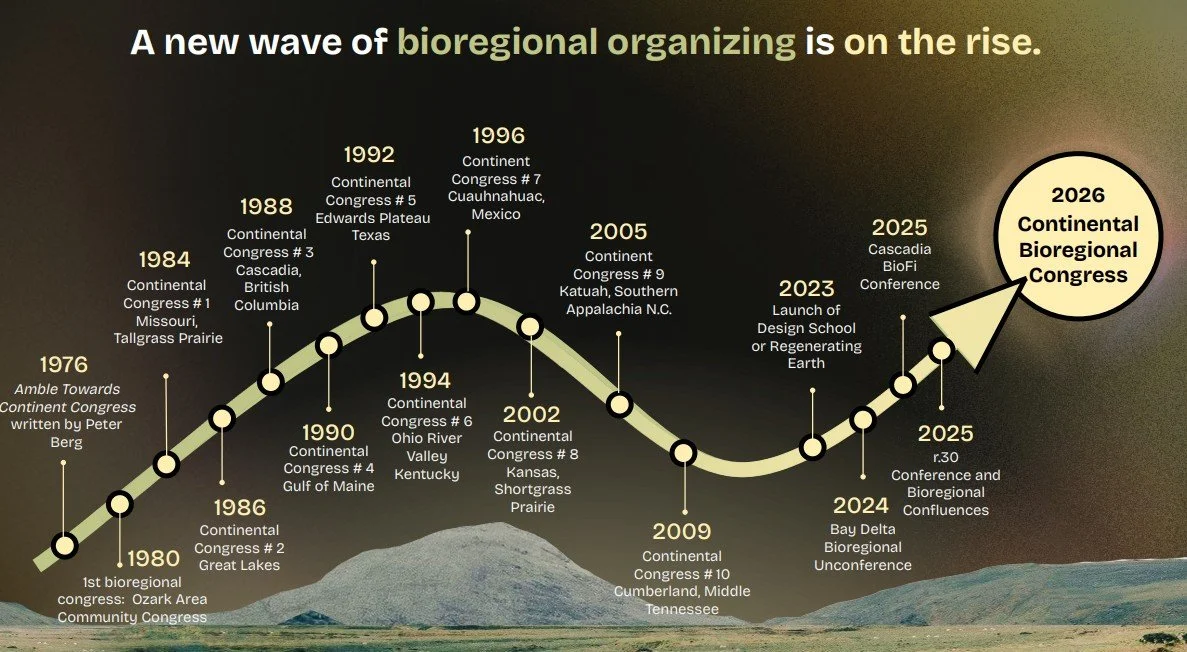
Graphic credit: Design School for Regenerating Earth, presentation, 2026.
At the founding bioregional congresses, participants began imagining governance and community structures aligned with watersheds and ecological nations rather than nation-states. Read here about the eleventh Turtle Island Bioregional Congress planned for September 15-19, 2026.
Cascadia has historically been rooted in bioregionalism; a systems-thinking approach that emphasizes living in harmony with natural boundaries of the land rather than the artificial lines of political borders. It symbolizes place as a shared identity rooted in environmental stewardship and cross-border camaraderie. Vancouver, BC shares a kinship with Seattle and Portland; as Depner notes, Vancouver is “a frequent cinematic body double for Seattle and other Pacific Northwest cities” and we see this kinship play out in everything from arts and culture to sports — including throughout the Major League Soccer season (and congratulations to the Vancouver Whitecaps, 2025). These shared cultural elements reinforce a regional identity that transcends national lines.

Cross-border camaraderie
For our organization (Cascadia Dept. of Bioregion) and many in the bioregional community, Cascadia is a vision of shared stewardship and responsible governance of place and people. Cascadia is an aspiration for society that uplifts environmental health, social wellbeing, and economic resilience. Image credit: Cascadia Cup Council
Read more about Cascadia Cup on Wikipedia.

BC Separatism and Misconceptions
Depner’s article also offers helpful insights into how scholars and analysts are examining the misconceptions about bioregionalism, and recent movements such as the B.C. Prosperity Project, along with other Western Canadian separatist groups.
These movements tend to focus on political disenchantment and economic grievances, often tied to anti-Ottawa sentiment. The rhetoric reflects feelings of alienation from mainstream national politics and, in some cases, alignment with similar movements in Alberta and Saskatchewan. Cascadian-Americans are resonating with this.
While feelings of alienation are real and deserve acknowledgment, they arise from a fundamentally different framework than bioregionalism.
Separatism and Power Over Models
Much of the current separatist rhetoric reflects what could be described as a “power-over” model, essentially, a structural and governance conversation centered on opposition to federal authority. There are indeed groups and organizations doing necessary work to halt or prevent extractive and unjust power structures, and we recognize the importance of that effort.
Bioregionalism is not primarily about fighting institutions for dominance or replacing one centralized authority with another. It is about shifting paradigms entirely, toward regenerative, place-based frameworks rooted in ecological realities and community resilience. Political analysts have noted that much of the current separatist energy in Western Canada aligns more closely with populist and partisan reaction than with ecological or bioregional values.

IMAGE CREDIT: NOV 15, 2016 SEATTLEPI.COM. Donald Trump's win has left some on the West Coast calling for secession. But join Canada? Above, a Pacific Northwest soccer fan flies the Doug Fir flag. The flag, drawn up by Cascadia secessionists, has since adopted by the region's soccer fans. Seattle.com.
Looking Ahead
As conversations about identity and governance continue to evolve, it is vital for Cascadians to distinguish between temporary political frustrations and long-term bioregional aspirations. Cascadia, as we understand and advocate for it, remains a positive, inclusive, and forward-looking movement; one that offers a compelling framework for how communities might thrive together in an era defined by ecological uncertainty and global change.
Kinship, not separatism. Regeneration, not reaction. That remains the heart of Cascadia.
—D.A.L.
Canada’s National Observer, Wolfgang Depner. 9 FEB 2026
See Depner’s complete article here.
